Children can have a hip replacement, but doctors rarely use it as the first response to childhood hip pain or deformity. The decision depends on the diagnosis, the amount of permanent joint damage, the child’s remaining growth and whether a hip-preserving operation could work; by the end, you will know which questions to ask before agreeing to surgery.
Key takeaways
- Child hip replacement is a rare salvage procedure for irreversible joint damage.
- Surgeons preserve a child’s natural hip whenever reconstruction remains feasible.
- X-rays, MRI scans and growth assessment guide treatment selection.
- Ask about implant choice, future revision risks and long-term follow-up.
When would a child actually need hip replacement surgery?
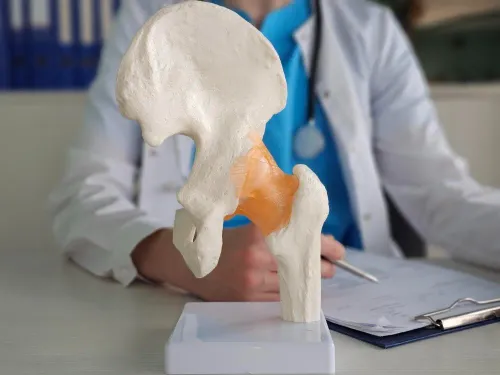
Children can have total hip replacement, but it is an uncommon salvage procedure, not a routine response to childhood hip pain. Surgeons consider it when the joint is irreversibly destroyed, causes major pain and disability, and hip-preserving treatment is unsuitable or has failed.
Possible reasons include:
- Severe juvenile idiopathic arthritis or another inflammatory disease that has destroyed the joint.
- Avascular necrosis, where loss of blood supply causes the femoral head to collapse.
- Developmental dysplasia of the hip or Perthes disease that has left severe deformity and arthritis.
- Haemophilic arthropathy caused by repeated bleeding into the joint.
- Infection-related destruction of the hip.
- Major trauma, including a badly damaged femoral head or acetabulum.
An abnormal X-ray alone does not justify replacement. A child may have dysplasia, deformity or early damage but still walk with little pain; that child needs diagnosis and monitoring, not an implant. Good children hip treatment separates a damaged hip that needs reconstruction from an unusual image without disabling symptoms.
The underlying diagnosis affects bone quality, component size and fixation, implant selection, and the risk of future revision. Because an implant does not grow with the child and may wear during a long lifetime, doctors usually preserve the natural hip whenever that remains realistic.
Families considering hip replacement surgery for children in Noida should ask whether the proposed operation is truly replacement, or a reconstructive procedure that could save the joint.
Why do surgeons try to preserve a child’s hip first?
A surgeon chooses preservation when the child’s symptoms, joint damage and remaining growth leave a realistic path to keeping the natural hip. An implant does not grow with the child, so delaying replacement can reduce the chance of multiple revision operations over a long lifetime.
1. Observe mild symptoms or an abnormal scan when pain, walking and hip function remain acceptable. Unnecessary surgery exposes a growing child to anaesthesia, complications and an implant that may wear before adulthood.
2. Start with physiotherapy, activity modification and medication when inflammation, weakness or mechanical irritation drives symptoms. Treating juvenile inflammatory disease can protect the hip more effectively than replacing it.
3. For developmental dysplasia, age determines the treatment. A baby may need a brace; an older child may need reduction to place the hip back in its socket, followed by a femoral osteotomy or pelvic osteotomy when bone shape prevents stable containment.
4. For Perthes disease or avascular necrosis, containment procedures, bone grafting or core decompression may preserve the femoral head before collapse. Once collapse produces severe, irreversible arthritis, preservation becomes less realistic.
5. Ask a child hip surgeon in Noida to explain whether the proposed paediatric hip surgery in Noida is preservation or replacement, and why. A children hip treatment plan must account for growth plates, skeletal maturity, diagnosis and bone quality—not only an X-ray.
Replacement becomes a salvage option when pain and disability are substantial, the joint is beyond reconstruction, and preservation has failed or cannot work.
What tests show whether replacement is appropriate?
A proper assessment does not decide on replacement from one abnormal X-ray. A hip replacement consultation in Noida should establish the diagnosis, measure disability, review previous treatment and determine how much growth remains.
- Describe pain: its location, duration, night symptoms and effect on sleep, school, play and self-care.
- Watch the walking pattern, including limping, foot position and whether the child avoids weight-bearing.
- Test hip range of motion and note pain, stiffness, muscle weakness and contractures.
- Measure both legs to identify a true or apparent leg-length difference.
- Review previous operations, injuries, infections, medicines, physiotherapy, bracing and other treatments.
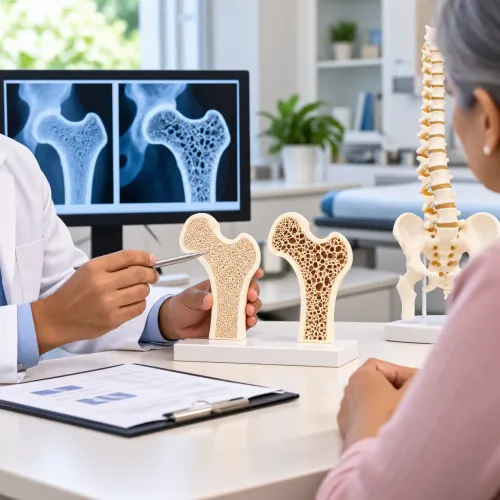
Standing pelvis and hip radiographs show alignment, joint-space loss, deformity and leg-length difference under load. Specialised views can define dysplasia, femoral-head collapse or the result of an osteotomy. MRI adds detail about cartilage, bone death, infection and soft tissues; CT helps map complex deformity, abnormal bone stock or anatomy changed by previous surgery.
Blood tests, including a complete blood count, inflammatory markers and disease-specific tests, help investigate infection or inflammatory disease. The team must also assess growth plates, skeletal maturity and remaining growth because an implant does not grow with the child.
A child who suddenly refuses to walk or bear weight needs urgent assessment, especially with fever or severe pain when the hip moves. Septic arthritis and other acute conditions require emergency evaluation, not an elective replacement consultation.
Which replacement or reconstruction is suitable for a growing child?
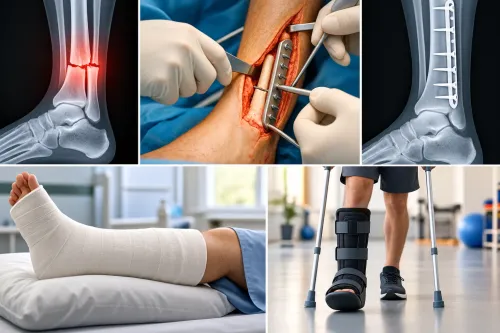
An implant does not grow with a child. If the natural joint can still be saved, reconstruction is usually preferable because delaying arthroplasty preserves bone and may avoid revision surgery during growth.
| Option | What it means | When it applies |
|---|---|---|
| Total hip replacement | Replaces the femoral head and socket with components; fixation may be cemented or cementless | Irreversible joint destruction causing major pain and disability |
| Partial replacement | Replaces the femoral head but leaves the natural socket | Selected femoral-head problems with a healthy socket, not a generally destroyed child’s hip |
| Hip resurfacing | Caps the femoral head and replaces the socket while retaining more bone | Carefully selected patients with adequate bone size, bone quality and skeletal maturity |
| Reconstructive surgery | Reshapes, repositions or repairs the child’s own hip | Dysplasia, Perthes disease, avascular necrosis or deformity when the joint remains salvageable |
Partial replacement is not a universal solution: a damaged socket can continue to cause pain, wear and instability after the new femoral head is inserted. Resurfacing also needs careful review of femoral-head size, growth plates, bone quality and maturity; a small or weak femoral head raises fracture and failure concerns.
Ask the surgeon to explain:
- Component size and whether fixation is cemented or cementless
- Bearing material, such as ceramic-on-polyethylene, and expected wear
- Risks of dislocation, infection, fracture, loosening and leg-length difference
- Activity limits, follow-up schedule and possible revision plan
No surgeon can promise an implant’s survival for one child. Diagnosis, bone quality, activity, device data and manufacturer evidence all matter; growth and years of loading may eventually require revision. A children hip treatment consultation should address these trade-offs directly.
How should families choose a Noida team and plan follow-up?
A child hip surgeon in Noida with paediatric orthopaedic training should lead the assessment, not an adult joint-replacement opinion alone. The surgeon must review hip development, open growth plates, dysplasia classification, bone quality and age-specific alternatives before discussing an implant.
| Role | Main contribution | What to verify |
|---|---|---|
| Paediatric hip surgeon | Development, growth plates, dysplasia and preservation or reconstruction | Training and experience with the child’s diagnosis |
| Joint-replacement surgeon | Complex reconstruction, implant selection and young-adult arthroplasty | Experience with small or deformed hips and revision planning |
| Paediatric reconstruction or high-volume young-adult team | Difficult anatomy, unusual diagnoses and long-term implant strategy | When and why referral is recommended |
Dr.A.K.Sharma-Ortho & joint replacement surgeon can provide an orthopaedic assessment in Noida, but ask whether the child needs referral to a paediatric orthopaedic reconstruction or high-volume young-adult arthroplasty team.
During a hip replacement consultation in Noida, take prior X-rays, MRI or CT scans, operation notes and medication records. Ask these questions:
- What hip-preservation options remain, including osteotomy, containment, core decompression or treatment of the underlying disease?
- Is the child still growing, and how does that change timing?
- Which implant, fixation method and bearing are proposed, and what evidence applies to that device in young patients?
- What restrictions will apply to school, sport and daily activities?
- Who will monitor growth, loosening and wear, and who will perform revision surgery if required?
For paediatric hip surgery in Noida, agree on the follow-up schedule, imaging plan and warning signs such as increasing pain, fever, wound discharge or loss of function before leaving the consultation.
Related service
Restore Mobility and Live an Active Life with Hip Replacement in Noida At Global Orthopaedics and Speciality Clinics, we specialize in helping... View service → |
Frequently asked questions
When would a child actually need hip replacement surgery?
A child may need total hip replacement when the hip joint is irreversibly destroyed, causes severe pain and disability, and hip-preserving treatment is unsuitable or has failed. It is uncommon and is not a routine treatment for childhood hip pain.
Why do surgeons try to preserve a child’s hip first?
Children’s bones and bodies continue growing, while hip replacements can wear out or require revision. Surgeons therefore consider reconstruction, correction of deformity or other hip-preserving treatments before replacement when those options can restore useful function.
What tests show whether replacement is appropriate?
The assessment can include a physical examination, standing or pelvis X-rays, MRI or CT scans, blood tests when infection is a concern, and an evaluation of skeletal maturity. These findings show joint damage, bone quality, deformity and remaining growth.
Which replacement or reconstruction is suitable for a growing child?
The choice depends on the child’s age, skeletal maturity, diagnosis, bone quality, activity level and the extent of joint destruction. A specialist may recommend hip reconstruction or preservation instead of replacement, while a replacement requires discussion of implant longevity and possible future revision.
How should families choose a Noida team and plan follow-up?
Choose a team experienced in paediatric hip surgery and complex reconstruction, and ask who will manage imaging, rehabilitation, growth-related concerns and complications. Before surgery, request a written follow-up plan covering wound review, physiotherapy, activity limits, implant monitoring and signs that require urgent assessment.
Keywords