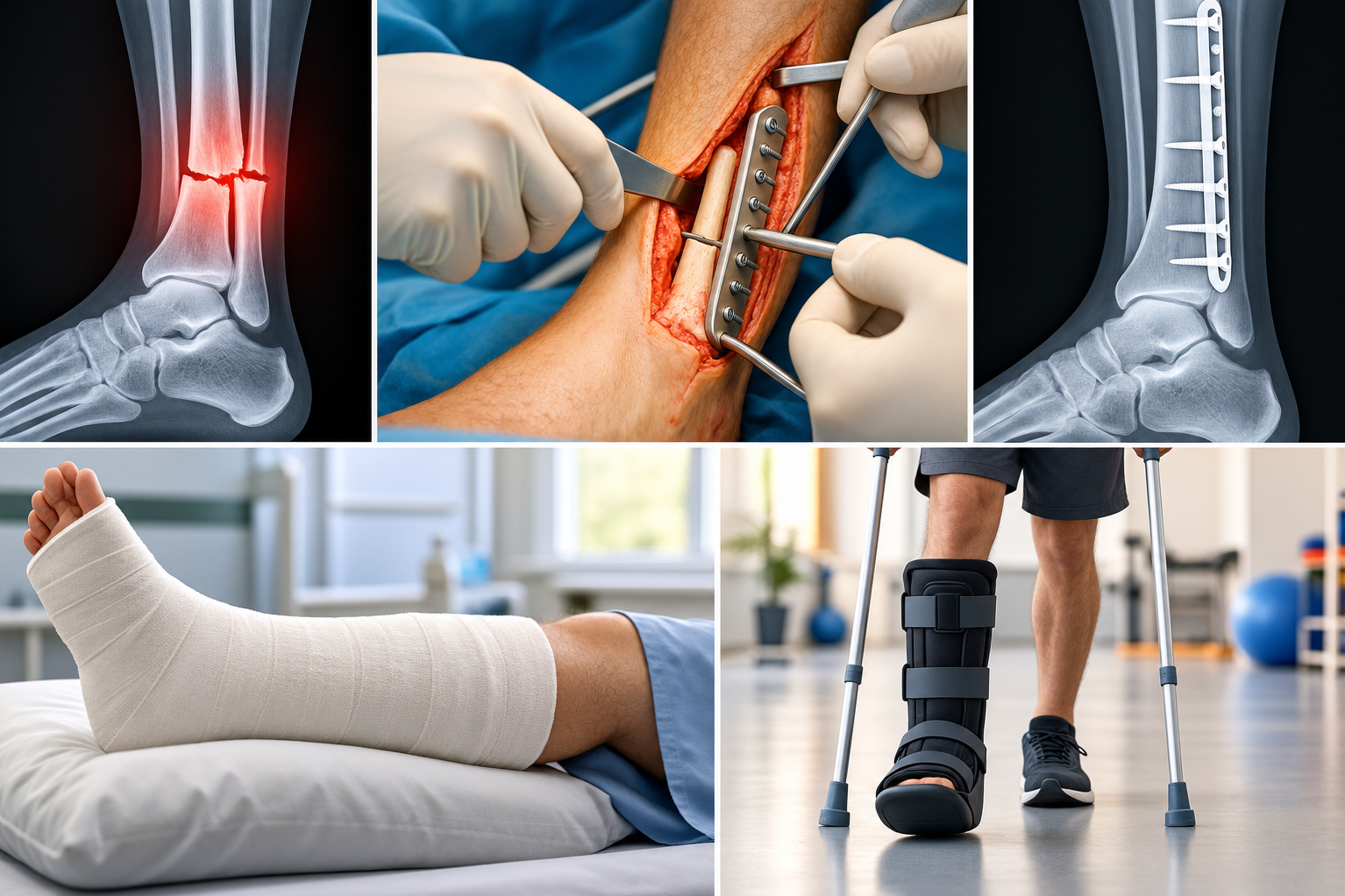
Some fractures can heal successfully in a cast, while others require surgical stabilization to restore alignment or protect function.
Fracture surgery treatment is generally considered when the injury is unstable, significantly displaced, open, or affects critical joint surfaces.
What Makes a Fracture Unstable?
A fracture may be unstable when bone fragments are unlikely to remain in a suitable position without fixation.
Factors can include:
- Severe displacement
- Multiple fragments
- Joint involvement
- Open injury
- Certain long-bone fractures
- Associated soft-tissue damage
The exact decision depends on the bone and injury pattern.
What Happens During Fracture Surgery?
The surgeon restores alignment and stabilizes the fracture.
Implants may include:
- Plates
- Screws
- Nails
- Wires
- Other fixation devices
The type of implant depends on the location and mechanical requirements of the fracture.
Why Is Alignment Important?
Poor alignment can affect:
- Joint movement
- Limb length
- Walking
- Strength
- Long-term function
This is particularly important when the fracture extends into a joint.
What Happens Before Surgery?
Patients may undergo:
- Blood tests
- Imaging
- Medical fitness assessment
- Medication review
- Anesthesia evaluation
Conditions such as diabetes or heart disease may need appropriate management.
What Happens After Surgery?
Postoperative care may include:
- Pain management
- Wound care
- Swelling control
- Movement instructions
- Weight-bearing guidance
- Physiotherapy
- Follow-up X-rays
Recovery differs widely between fracture types.
Do Implants Always Need Removal?
Not necessarily.
Many plates and screws can remain unless there is a specific reason for removal.
Patients should discuss this directly with the treating surgeon.
What Are Important Warning Signs?
After surgery, report:
- Increasing wound redness
- Persistent discharge
- Severe swelling
- New numbness
- Circulation changes
- Unusual worsening pain
- Fever when clinically concerning
Choosing Surgical Care
Patients should understand why surgery is being recommended and what it is expected to achieve.
Dr. A.K. Sharma, Ortho and Joint Replacement Surgeon evaluates fractures in Noida and determines whether conservative treatment or operative fixation is appropriate.
The goal of fracture surgery is not simply to fix an X-ray. It is to restore suitable stability and alignment so healing can occur while protecting long-term function.
Keywords