Back pain after an injury, with weakness, numbness, fever or bladder changes, needs a different response from a mild strain that is already improving. You will be able to sort symptoms by urgency, choose the right clinician, prepare for an assessment and understand when tests or treatment are justified.
Key takeaways
- Seek emergency care for bladder, bowel, saddle numbness or severe leg weakness.
- Book a same-week appointment for persistent, worsening or leg-radiating back pain.
- Record pain triggers, duration, weakness, numbness, medicines and previous injuries.
- Review treatment if symptoms worsen or fail to improve within the agreed timeframe.
Which back-pain symptoms need emergency care or a same-week appointment?
New difficulty passing urine, loss of bladder or bowel control, numbness around the genitals or anus, or severe or worsening weakness in both legs requires emergency care. These are possible cauda equina warning signs.
After a road crash or fall, severe pain with weakness, numbness or inability to walk also requires calling 112 or going to an emergency department, not a routine clinic.
| Urgency | What to do | Symptoms or situation |
|---|---|---|
| Emergency | Call 112 or visit an emergency department | Cauda equina warning signs, significant trauma with neurological symptoms, inability to walk, or rapidly worsening weakness |
| Same-week appointment | Book an orthopaedic assessment | Fever, unexplained weight loss, marked night pain, previous cancer, osteoporosis, immunosuppression, intravenous drug use, persistent or recurrent pain, or leg numbness and weakness |
| Short-term self-care | Keep moving within tolerance and monitor | Mild pain after an ordinary movement when strength and sensation are normal, no red flags exist, and symptoms are improving |
Fever with severe illness, confusion or rapidly worsening pain needs emergency assessment rather than a clinic appointment. Otherwise, these warning features answer when to see an orthopaedic doctor for back pain in noida: arrange a same-week review when symptoms persist, recur, limit walking or sleep, or suggest nerve irritation.
Do not treat every painful episode as an emergency. Pain that steadily improves without neurological changes can be watched briefly.
What do the symptoms suggest: strain, nerve irritation, fracture or inflammation?
A local ache or stiffness after lifting, exercise or an awkward movement points more towards muscle strain, especially when movement triggers pain but strength and sensation remain normal. Pain that travels into the buttock and below the knee suggests nerve-root irritation or disc-related pain.
| Pattern | Clues | What it suggests |
|---|---|---|
| Muscle strain | Local aching or stiffness after movement; pain changes with movement; no numbness or weakness | Muscle or ligament strain |
| Nerve irritation | Burning pain into the buttock or below the knee, tingling, numbness or weakness | Disc-related nerve-root irritation |
| Spinal stenosis | Leg pain, heaviness or numbness during standing or walking that eases when sitting or leaning forward | Narrowing around spinal nerves |
| Fracture | Sudden, focal pain after a fall or minor impact, particularly with osteoporosis | Vertebral fracture |
| Inflammation | Morning stiffness lasting a long time, night pain, improvement with movement, onset before age 40 | Inflammatory back condition |
A back pain orthopaedic doctor in Noida must match the scan to your symptom distribution and examination. An MRI disc bulge does not prove that the bulge caused your pain; disc bulges and degenerative changes also appear in people without symptoms.
Persistent pain, recurring episodes, leg symptoms or an uncertain diagnosis deserve clinical assessment, while progressive weakness requires faster review.
Which clinician should you see for each back-pain problem?
Choose urgency before specialty. Go to an emergency department, or call 112, for possible cauda equina symptoms, major trauma, rapidly worsening weakness or inability to walk. New difficulty passing urine, bladder or bowel loss, or numbness around the genitals or anus needs urgent assessment.
| Clinician | Best fit | When to choose |
|---|---|---|
| Emergency department | Immediate assessment and hospital treatment | Cauda equina symptoms, severe weakness, inability to walk, or back pain after a major crash or fall |
| Orthopaedic doctor | First assessment of bone, joint and mechanical problems | Pain with movement, suspected fracture, persistent or recurrent pain, or an unclear diagnosis |
| Spine specialist | Focused spinal assessment and treatment planning | Persistent nerve symptoms or failed non-operative care; a spine specialist in Noida may be an orthopaedic spine surgeon or a neurosurgeon |
| Neurosurgeon | Specialist spinal and nerve-surgery assessment | Progressive neurological loss, spinal cord or nerve compression, or a surgical opinion after examination |
| Neurologist | Assessment of nerve, muscle or non-spinal causes | Symptoms do not follow a spinal pattern, or peripheral nerve or muscle disease is possible |
| Physiotherapist | Exercise-based rehabilitation | After serious causes are screened; treatment can accompany medical care, not replace it when weakness, fever or trauma is present |
Choose a spine specialist by training, neurological examination, access to non-operative treatments and emergency pathways—not by title alone. An orthopaedic doctor is a sensible starting point for most mechanical back pain.
What should you record, and what happens at the first assessment?
Record the pain pattern and your medical history before seeking orthopaedic care for back pain. Write down:
- When the pain began, what caused it, its exact location, and whether it travels below the knee.
- Numbness, weakness, fever, weight change, night pain, previous cancer, osteoporosis, recent infection and any injuries.
- Every current medicine, including painkillers, steroids, supplements and medicines bought without prescription.
- Whether walking, sitting, coughing, sleeping or exercising makes the pain better or worse. Bring previous X-rays, MRI scans, blood-test results and treatment notes.
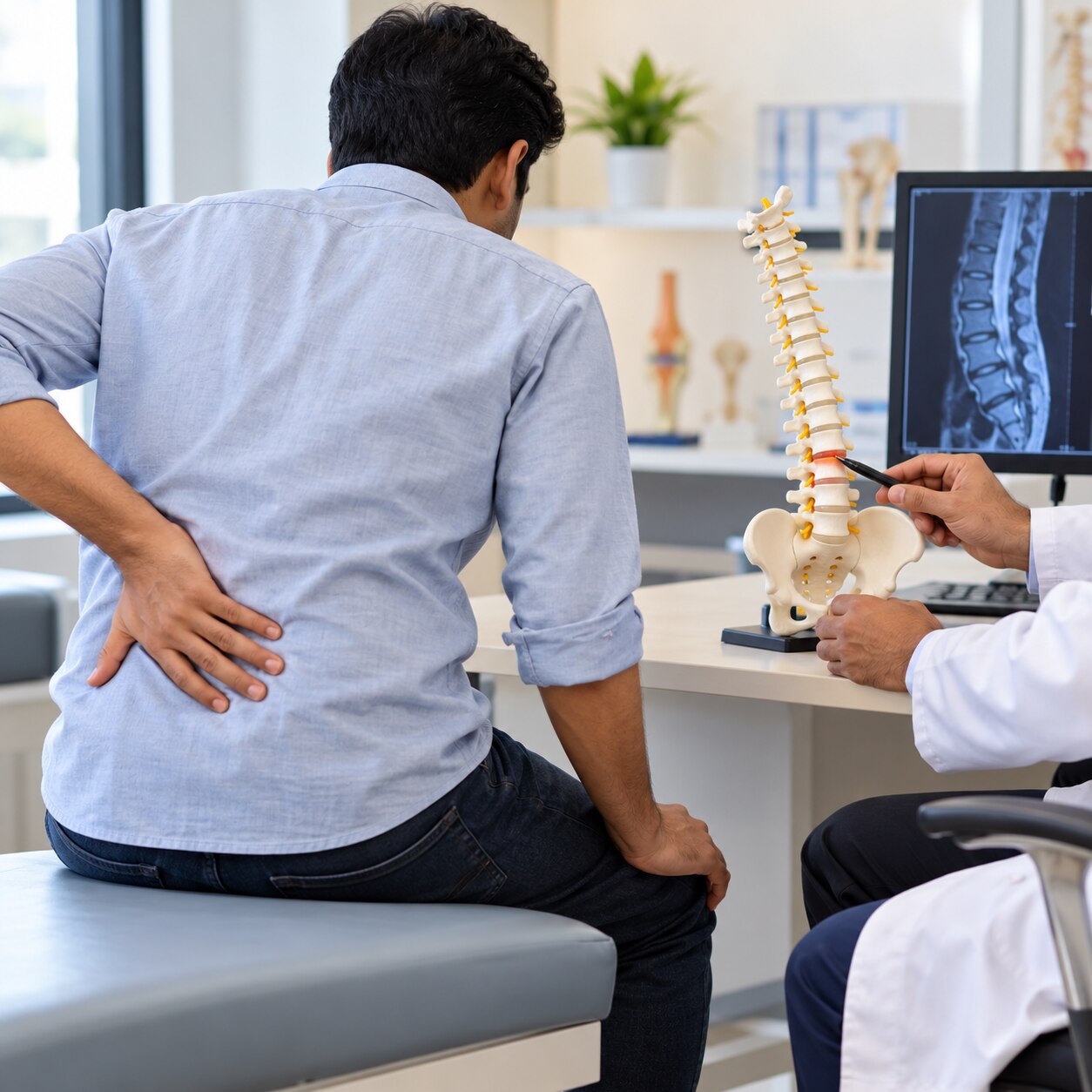
At the first assessment, the clinician reviews this history, observes your gait and posture, tests spine movement, and checks reflexes, sensation and muscle strength. A straight-leg-raise test is added when the symptoms suggest nerve-root irritation. These findings help distinguish a muscle problem from nerve compression, fracture, infection or another cause.
Imaging answers specific questions rather than simply confirming that pain exists. X-rays assess fracture, alignment and advanced bony change; MRI shows discs, nerves, infection and soft tissue; CT provides detailed bone images when a fracture or complex anatomy needs clarification. Blood tests support investigation of infection, inflammation or malignancy.
Without red flags or neurological deficits, routine imaging is not automatically useful. MRI is generally considered after about six weeks of appropriate care when symptoms persist or progress and an intervention is being considered.
How long can you monitor back pain, and when does treatment need review?
Mild back pain that is clearly improving can be monitored for the next few weeks. Keep moving within tolerance, avoid prolonged bed rest and follow a structured exercise approach; resting in bed can prolong stiffness and reduce strength.
Arrange clinical review when:
- Pain is not clearly improving after a few weeks.
- It keeps returning or limits work, sleep or walking.
- Pain, numbness or weakness persists despite normal activity, exercise-based care and suitable medication.
- You are unsure whether the pain is coming from the spine, hip or another cause.
These are practical points for deciding when persistent back pain treatment needs reassessment and when orthopaedic care for back pain is reasonable in Noida.
If you use a non-steroidal anti-inflammatory drug, use the lowest effective dose for the shortest possible period. Discuss stomach-ulcer, kidney and cardiovascular risks, drug interactions and gastroprotection when appropriate. Paracetamol alone is not recommended for low-back pain. For sciatica, NICE advises against gabapentinoids, oral corticosteroids and benzodiazepines, and against opioids for chronic sciatica.
Surgery is not the routine next step. Decompression is considered only when matching sciatica has not improved with non-surgical care and examination and imaging support the decision; fusion is not recommended for nonspecific low-back pain outside research.
A consultation with Dr.A.K.Sharma-Ortho & joint replacement surgeon can connect your symptoms, examination and options without treating an MRI report in isolation.
Frequently asked questions
Which back-pain symptoms require emergency care?
New difficulty passing urine, loss of bladder or bowel control, numbness around the genitals or anus, or severe or worsening weakness in both legs requires emergency care.
When should you see an orthopaedic doctor for back pain in Noida?
Arrange a same-week appointment for persistent or worsening pain, pain spreading into a leg, numbness, weakness, pain after an injury, or symptoms that limit walking and daily activities.
What can back-pain symptoms suggest?
Pain after lifting or overuse often fits a strain; leg pain with tingling or numbness suggests nerve irritation; pain after a fall raises concern about fracture; prolonged morning stiffness or multiple painful joints can point to inflammation.
What should you record before a back-pain assessment?
Note when the pain began, its location and severity, triggers, leg symptoms, bladder or bowel changes, fever, weight loss, injuries, medicines and treatments already tried.
How long can you monitor back pain before seeking treatment review?
Follow the review timeframe agreed with your clinician. Seek earlier care if pain worsens, new weakness or numbness appears, or bladder and bowel symptoms develop.
Keywords