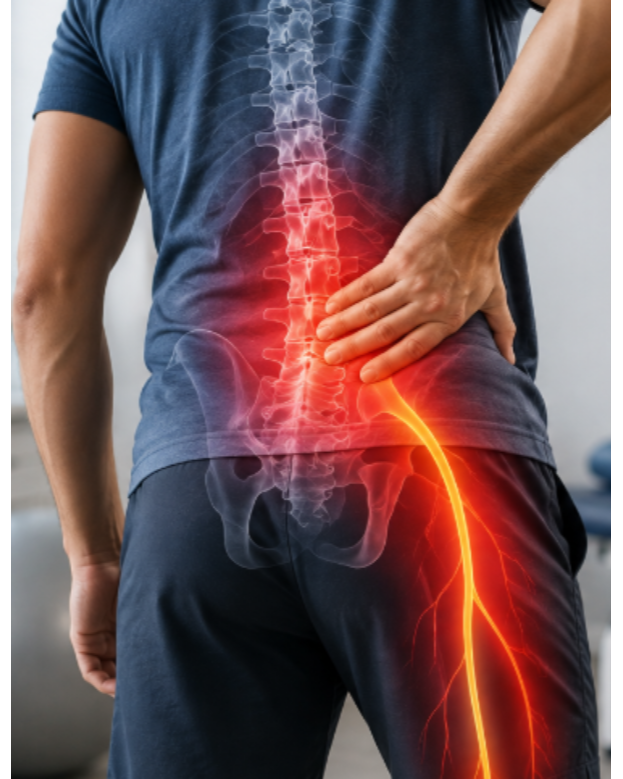
Sharp pain travelling from the lower back or buttock into the leg is often described as sciatica. Some people experience mild intermittent discomfort, while others develop severe radiating pain, tingling, numbness, or weakness that interferes with walking and sleep.
When considering sciatica treatment, patients frequently want to know whether physiotherapy and medication are sufficient or whether surgery will eventually be necessary.
The answer depends on the cause, neurological findings, symptom severity, duration and response to appropriate conservative care.
What Is Sciatica?
Sciatica describes symptoms associated with irritation or compression affecting the sciatic nerve pathway or the nerve roots contributing to it.
A lumbar disc problem is one possible cause, but it is not the only one.
The pain may extend from the lower back into the buttock and travel down the thigh or leg. Depending on the affected nerve, numbness, tingling or weakness may occur in particular areas.
Conservative Management
When there are no urgent neurological concerns, many patients are initially managed without surgery.
The treatment plan may include:
- Appropriate medication
- Modification of aggravating activities
- Guided physiotherapy
- Mobility exercises
- Progressive strengthening
- Gradual return to normal activity
Treatment should be adapted to the underlying diagnosis and stage of recovery.
For example, an exercise that suits one patient may aggravate another person's symptoms if their condition is different.
What Does Imaging Add?
MRI can help visualize discs, nerves and other structures in the lumbar spine when imaging is clinically indicated.
Yet an abnormal scan does not automatically mean an operation is necessary.
Disc bulges and degenerative changes can occur without producing severe symptoms. The key question is whether the imaging finding corresponds with the patient's pain pattern and examination.
When Does Surgery Become Relevant?
Surgical treatment may be considered when there is significant nerve compression associated with appropriate clinical findings, progressive weakness, or persistent disabling symptoms despite suitable conservative management.
Some neurological presentations require more urgent evaluation.
Changes in bladder or bowel control, numbness around the saddle region, or rapidly worsening weakness should not be managed as routine back pain.
Conservative Care and Surgery Have Different Roles
It is misleading to treat physiotherapy and surgery as competing solutions where one is always “better.”
Conservative care aims to manage suitable conditions without an operation while restoring function.
Surgery, when appropriately indicated, aims to address a structural problem that is producing clinically significant symptoms.
The correct choice depends on whether the patient's condition fits the indication for that treatment.
Questions to Ask During Evaluation
Rather than asking only, “Will I need surgery?” patients can ask:
- Which nerve appears to be affected?
- What is causing the nerve irritation?
- Do my examination findings match the MRI?
- Is there any muscle weakness?
- Can conservative management reasonably be tried?
- What signs would change the treatment plan?
- What activities should I temporarily modify?
- How will progress be measured?
These questions encourage a diagnosis-based approach.
Do Not Judge Recovery by Pain Alone
Pain is important, but neurological function also matters.
During follow-up, clinicians may evaluate strength, sensation, reflexes, walking ability, leg symptoms and overall function.
A patient whose pain fluctuates but strength remains stable may require a different approach from someone developing progressive weakness.
For residents of Noida, Uttar Pradesh, who spend substantial time sitting, driving or commuting around Delhi NCR, radiating leg pain can quickly interfere with work and mobility. Still, lifestyle factors should not be used to explain away persistent neurological symptoms.
Dr. A.K. Sharma, Ortho and Joint Replacement Surgeon can evaluate the relationship between spinal symptoms, nerve function and imaging when clinically required.
The practical goal of sciatica treatment is not simply to suppress pain. It is to identify the source of nerve-related symptoms, monitor neurological function and choose the least invasive treatment that is appropriate for the actual condition.