Recreational athletes need to separate access to medical care from insurance payment: a weekend football injury is still a sports injury, but the policy may treat consultation, imaging, physiotherapy and surgery differently. You will be able to judge the urgency, prepare for assessment, understand when imaging is useful and compare treatment options for a safe return to activity.
Key takeaways
- Use home care for mild injuries without deformity, numbness or loss of function.
- Seek emergency care for severe pain, deformity, head injury or inability to bear weight.
- Imaging depends on examination findings, injury mechanism and suspected bone or joint damage.
- Return to sport after pain-free movement, restored strength and sport-specific drills.
Do recreational athletes receive the same sports-injury care as professionals?
Yes. Recreational participation is not a reason to refuse evaluation or treatment.
A runner with a stress fracture, badminton player with an ankle sprain, cricketer with shoulder pain, footballer with an ACL injury, gym trainee with a muscle strain, cyclist with a fracture, swimmer with rotator-cuff pain or weekend-league player with knee pain follows the same clinical pathway as a professional athlete.
1. Establish what happened and when. The assessment should record the movement or impact, training changes, previous injuries, swelling, instability, locking, numbness and difficulty bearing weight or using the limb.
2. Examine the injured tissue and assess function. A sports injury doctor commonly treats sprains, dislocations, fractures, tendon and muscle injuries, stress injuries and overuse conditions. X-rays, MRI or ultrasound are selected when examination findings justify them; a normal X-ray does not exclude every ligament, tendon, cartilage or early stress injury.
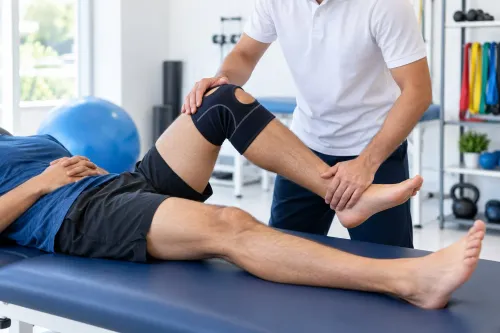
3. Match treatment to your goals. Care may include protection and symptom control, restored movement, progressive strength and balance work, sport-specific loading, and follow-up before returning to activity. Your work, exercise routine and sporting demands matter, so being pain-free for one day does not prove readiness.
4. Separate treatment access from insurance payment. Check whether your policy covers outpatient consultation, accidental-injury claims, diagnostic imaging, physiotherapy, network hospitals and pre-authorisation. Ask whether you need a referral, claim intimation or cashless approval before treatment.
For sports injury treatment for recreational athletes in Noida, ask whether the service provides examination, appropriate imaging, rehabilitation guidance and follow-up—not only pain tablets, an injection or a scan report.
When should you use home care, a doctor, physiotherapy or emergency care?
Stop playing immediately if pain changes your movement, the joint feels unstable, swelling appears quickly, or you cannot use the limb normally. During the first 24 hours, protect the area and reduce activity without staying completely still.
Use an ice pack wrapped in cloth for 15–20 minutes, apply snug compression without causing numbness, and elevate the limb while resting. Avoid massage and heat while swelling is increasing.
- Use home care for a minor injury that is improving: relative rest, gentle movement and symptom control. Arrange a general physician or sports assessment for persistent or recurrent pain, bruising, reduced range of motion, or difficulty walking and managing daily tasks.
- Choose physiotherapy when examination confirms a condition suited to exercise-based rehabilitation. The clinician must first exclude a fracture, dislocation or serious tear.
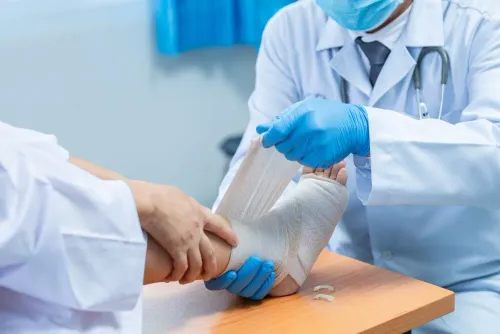
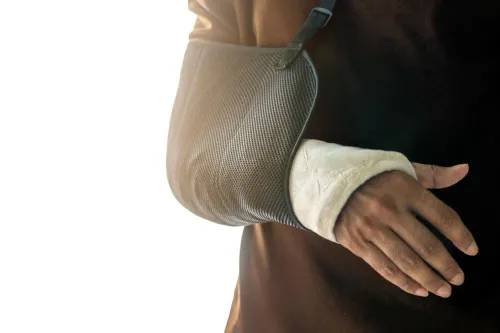
- Seek emergency care for visible deformity, an open injury, suspected fracture or dislocation, inability to bear weight after significant trauma, a locked joint, severe swelling after a pop, numbness, a cold or pale limb, loss of circulation, severe pain out of proportion, concerning head-injury symptoms or breathing difficulty.
Ordinary post-exercise soreness usually affects both sides or the muscles you worked, appears after a delay and eases as you move. Focal or worsening pain, swelling, bruising, weakness, or pain during ordinary walking needs examination; impact-related pain that progresses can signal a stress fracture.
Treatment for sports injuries works best when assessment and rehabilitation match the diagnosis.
What happens during the appointment, and when is imaging justified?
An appointment starts with a history, not a scan. Bring the injury date, the movement that caused it, previous injuries, medications, prior reports, and details of swelling, bruising, instability, locking, numbness and difficulty bearing weight.
Your sports injury doctor for recreational athletes will examine the area and compare it with the uninjured side:
- Expect checks for swelling and bruising, range of motion, muscle strength, movement pattern and joint stability.
- For an ankle injury, the Ottawa Ankle Rules support an X-ray when there is tenderness at the posterior edge or tip of either malleolus, the navicular or the base of the fifth metatarsal, or when you cannot take four steps immediately and during assessment.
- X-rays show many fractures and joint alignment. They do not reliably show ligament, tendon or cartilage damage, and an early stress injury can remain invisible.
- MRI is useful when examination suggests an ACL, meniscus, tendon, muscle or other soft-tissue injury, or when symptoms persist. Ultrasound assesses selected superficial tendons and can guide some procedures; CT is mainly for complex bone injuries.
Imaging is justified for suspected fracture, a locked knee, persistent symptoms or suspected ligament or tendon damage. Not every sprain needs an MRI. A normal X-ray does not exclude every important injury, while an MRI can reveal an incidental abnormality unrelated to your pain.
The clinician must match the image to physical findings before identifying the pain source or choosing treatment.
How is treatment planned, and what proves you are ready to return?
Treatment is usually staged: confirm the injury, protect the tissue and control symptoms, restore movement, rebuild strength and balance, add sport-specific loading, then test a graded return. Pain medicines, injections or passive treatments do not replace rehabilitation or correcting an excessive training load.
An uncomplicated ankle sprain usually allows early weight-bearing as tolerated, range-of-motion exercises, strengthening and balance training. A severe sprain may need brief immobilisation; prolonged inactivity increases stiffness and weakness.
Tendinopathy needs temporary load modification followed by progressive strengthening, such as heavy-slow resistance or a correctly dosed eccentric programme. Improvement often takes weeks or months, not a few treatment sessions.
Reduce impact and arrange assessment for a suspected stress fracture even when an early X-ray is normal. An ACL injury does not automatically require immediate reconstruction; repeated instability, meniscus or cartilage damage, and goals involving pivoting sports influence that decision.
After a suspected concussion, leave play even without loss of consciousness. Same-day return is not recommended; a stepwise return normally allows at least 24 hours at each stage and advances only when symptoms do not worsen.
Use this return-to-sport checklist, adapted to your injury and sport:
- Full or near-full movement without a compensating pattern
- Strength symmetry appropriate for the injured limb and sport
- Stable balance and controlled single-leg tasks
- Pain-free or symptom-stable hopping, landing or change-of-direction work
- Tolerance of gradually increasing training load
- No swelling, giving-way or worsening symptoms after practice
One pain-free day does not prove readiness. Your ability to perform the sport’s demands matters more.
How should you choose a sports injury clinic and verify payment in Noida?
Choose a clinic by the care pathway it provides, not by a scan, injection or promise of quick recovery. Before booking a sports injury clinic in Noida, ask who will examine you, who will review progress after the first visit, and how rehabilitation will be managed.
- Does the assessment include a physical examination and access to appropriate X-ray, ultrasound or MRI when findings justify imaging?
- Will you receive planned follow-up, rehabilitation or physiotherapy, and advice on modifying work, exercise and training load?
- What are the return-to-sport criteria, such as restored movement, strength, balance and sport-specific loading?
- What stages of care are estimated: diagnosis, protection, movement, strengthening, sport-specific work and monitored return?
| Service | What you receive | Risk of choosing it alone |
|---|---|---|
| Full pathway | Examination, imaging when indicated, rehabilitation and follow-up | Progress is measured against function |
| Injection or tablets only | Temporary symptom control | The injury, weakness or excessive training load may remain |
| Imaging report only | Pictures and a written interpretation | The scan may not identify the pain source or treatment plan |
Call your insurer with the diagnosis or injury description. Ask about outpatient benefits, accidental-injury exclusions, network status, pre-authorisation, deductibles and reimbursement documents. Dr.A.K.Sharma-Ortho & joint replacement surgeon is one Noida option to compare on these standards. Take your policy card, identification, reports and medication list; keep receipts and prescriptions for reimbursement.
Related service
Get Back in the Game: Expert Sports Injury Treatment in Noida Are you a athlete sidelined by a sports injury? At Global Orthopaedics and Speciality... View service → |
Frequently asked questions
Do recreational athletes receive the same sports-injury care as professionals?
Yes. Recreational athletes receive evaluation and treatment based on the injury, symptoms, function and recovery goals—not professional status.
When should you choose home care, a doctor, physiotherapy or emergency care?
Use home care for mild symptoms that improve with rest, ice, compression and elevation. See a sports injury doctor for persistent pain, swelling, reduced movement or difficulty using the limb. Physiotherapy helps restore mobility, strength and coordination. Seek emergency care for deformity, severe pain, suspected fracture, numbness, major bleeding or inability to bear weight.
What happens during a sports injury appointment, and when is imaging justified?
The clinician reviews how the injury occurred, checks swelling, tenderness, movement, strength and stability, then decides whether imaging is needed. X-rays help assess suspected fractures, while ultrasound or MRI may be considered for selected tendon, ligament, cartilage or muscle injuries.
How is treatment planned, and what proves you are ready to return?
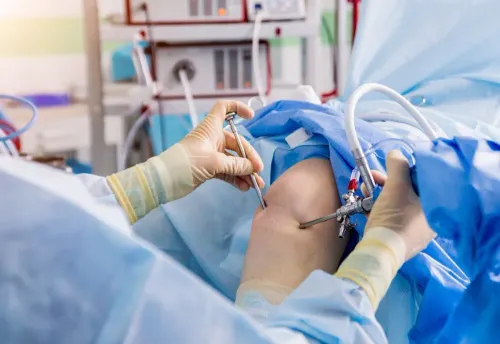
Treatment may combine activity modification, pain control, bracing, physiotherapy or surgery when indicated. Return when pain and swelling are controlled, movement and strength are restored, and you can complete sport-specific drills without symptoms.
How should you choose a sports injury clinic and verify payment in Noida?
Check the clinician’s orthopaedic qualifications, sports-injury experience, examination process, imaging access and rehabilitation plan. Before treatment, confirm consultation fees, test charges, package inclusions, insurer or cashless eligibility, and the written receipt or claim documents you will receive.
Keywords