The better choice depends on whether your pain and loss of function come from advanced hip-joint damage, whether a structured non-surgical plan has been tried, and how much the condition is disrupting sleep and independence. By weighing symptoms, examination findings, imaging, medical risks and realistic goals, you can decide whether to continue treatment, seek another opinion or discuss replacement surgery.
Key takeaways
- Preserved independence and manageable pain usually support continued treatment.
- Confirm the hip joint is causing pain before choosing surgery.
- Try activity changes, physiotherapy, medicines, and injections when appropriate.
- Consider replacement when pain and disability persist despite well-delivered treatment.
When does continued treatment make more sense than hip replacement?
Mild or manageable pain with preserved independence usually favours continued treatment over hip replacement. If you can walk, climb stairs, sleep without major disruption and manage washing, dressing and household tasks, surgery may expose you to risks without solving an urgent problem.
Continued treatment also makes more sense when the diagnosis is not advanced hip arthritis, symptoms have not yet been addressed through a structured plan, or another condition may be causing the pain. Treat uncontrolled diabetes, anaemia, active infection, serious heart or lung disease, smoking and poor nutrition before elective surgery.
Reassessment is warranted when hip symptoms start changing what you can do:
- Pain persists despite an appropriate treatment plan.
- Pain wakes you at night or prevents restful sleep.
- Your walking distance has sharply decreased.
- You struggle to put on socks, climb stairs or rise from a chair.
- You rely repeatedly on a walking aid.
- Pain stops you from working, exercising or managing daily tasks.
- You lose independence or need regular help.
An abnormal X-ray alone does not justify surgery. The hip surgery decision should match the severity and location of pain, examination findings, imaging and your informed preference; lumbar-spine disease, sacroiliac pain or knee disease can produce similar symptoms. Age alone should neither force nor rule out replacement.
When comparing hip replacement or other treatment in Noida, choose the option that explains your symptoms and protects your function, not the one based only on a scan.
Which hip arthritis treatment options should you try first?
Try a documented non-operative plan before choosing surgery. It should reduce strain without complete inactivity and include:
- Activity modification: avoid painful impact and deep flexion, but keep moving within tolerable limits.
- Physiotherapy: restore hip range of motion and strengthen the gluteal and core muscles.
- Low-impact aerobic exercise: walking on level ground, cycling or swimming.
- Weight management when appropriate: reducing excess load can ease symptoms and improve mobility.
- A cane in the hand opposite the painful hip, fitted so your elbow bends slightly when the tip rests on the ground.
| Option | What it does | When it helps |
|---|---|---|
| Physiotherapy and exercise | Improves movement, strength and endurance | Pain with weakness or stiffness |
| Heat or ice | Temporarily eases stiffness or soreness | Before activity or after a painful session |
| Topical or oral NSAIDs | Reduces inflammatory pain | Only after reviewing kidney disease, ulcers, blood thinners, blood pressure and other risks |
| Corticosteroid injection | Provides short-term relief for some patients | When pain blocks rehabilitation; it does not restore cartilage |
Tell the operating surgeon about every hip injection. An injection within about three months before replacement raises concern about infection risk.
Hip arthroscopy is not a general substitute for advanced arthritis. It suits selected patients with impingement or labral disease; hip-preservation treatment, including osteotomy for a structural deformity, may help before end-stage cartilage loss.
This pathway has failed when severe or night pain continues, walking worsens, or major function is lost despite an appropriate documented plan. At that point, reassess rather than rely indefinitely on a cane or medicines.
How can you confirm that the hip joint is actually causing the pain?
Pain in the groin, buttock, thigh or knee does not prove that the hip joint is the source. Your history should record which movements worsen it, whether it wakes you at night, how far you can walk, and whether stairs, socks or shoes have become difficult.
The examination should test hip range of motion, observe your gait, check leg length and muscle strength, and include a neurological examination. These findings help separate joint arthritis from:
- Lumbar-spine disease
- Sacroiliac pain
- Greater trochanteric pain syndrome
- Tendon injury
- Knee disease
- Referred pain
Ask for standing pelvis and hip X-rays. The clinician should compare joint-space loss, osteophytes, deformity or femoral-head damage with the painful side, your examination and your walking pattern.
Ask the clinician to show you the standing X-ray and explain whether the visible abnormality matches your pain; an abnormal image alone does not justify a hip surgery decision.
MRI is useful when X-rays do not explain symptoms or when a stress fracture, tendon or labral injury, avascular necrosis, tumour or other soft-tissue problem is suspected. Blood tests help investigate inflammatory arthritis or infection when your history and examination raise those concerns.
If symptoms and imaging disagree, continuing diagnostic evaluation or seeking a second opinion is safer than operating on the X-ray. That confirmation determines whether hip arthritis treatment options remain appropriate or replacement has a sound basis.
When does hip replacement become a reasonable option?
Surgery becomes a serious treatment choice when substantial pain persists despite a structured non-surgical plan, and walking, stairs, work, daily activities or sleep are seriously limited. Examination must support hip-joint disease, while standing X-rays show joint-space loss, osteophytes, deformity or other damage that matches the symptoms. An abnormal X-ray alone is not enough.
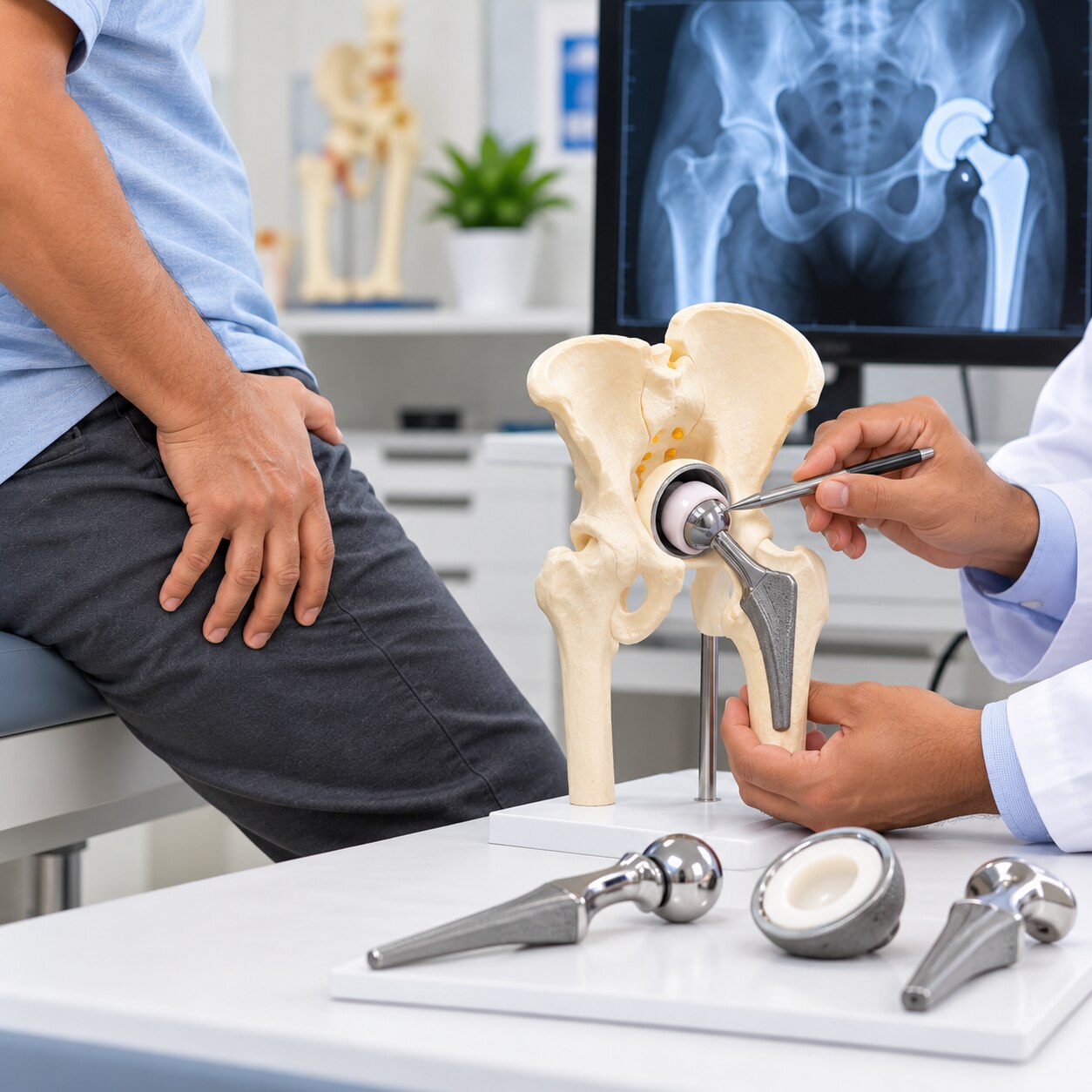
Total hip replacement replaces both the femoral head and damaged acetabular surface. Resurfacing preserves more femoral bone, but requires suitable bone quality, anatomy and implant-risk assessment; it is not appropriate for everyone.
| Option | What it replaces or preserves | Main decision point |
|---|---|---|
| Total hip replacement | Replaces the femoral head and acetabular surface | Used when joint destruction and symptoms justify replacement |
| Hip resurfacing | Caps the femoral head and preserves more femoral bone | Requires careful selection and is unsuitable for some patients with poor bone quality or metal-related risks |
Replacement can substantially reduce pain and improve function, but it does not promise a normal or unlimited hip. Discuss dislocation, infection, blood clots, fracture, nerve injury, leg-length difference, persistent pain, loosening, wear and later revision.
Recovery is staged: assisted walking often starts soon after surgery, while strength, gait confidence and endurance improve over several months. Address smoking, diabetes, obesity, anaemia, nutrition, dental or skin infection, blood thinners, and heart or lung disease first.
A consultation with Dr.A.K.Sharma-Ortho & joint replacement surgeon in Noida can connect your examination, X-rays, diagnosis and health risks to a personalised hip surgery decision, including advice against surgery when it is premature or unsuitable.
Ask the hip replacement specialist in noida to explain implant survival for the proposed device rather than promise a fixed lifespan.
Related service
Restore Mobility and Live an Active Life with Hip Replacement in Noida At Global Orthopaedics and Speciality Clinics, we specialize in helping... View service → |
What should you ask before choosing surgery or continued treatment in Noida?
Choose the option that explains your pain, matches your risk profile and gives you a clear next step. Use this checklist when comparing hip replacement or other treatment in Noida with hip replacement alternatives:
- What diagnosis explains my symptoms, and can you show me the standing X-ray?
- What specific non-operative step comes next, for how long, and what pain or functional change would trigger reconsideration?
- If surgery is proposed, which implant, bearing surface and fixation method are planned, and why? Which surgical approach is recommended?
- What range of motion is realistic, and how will you address a leg-length difference?
- What are the expected hospital stay, blood-loss plan, thrombosis-prevention plan, wound review and activity restrictions?
- Who will manage diabetes, blood thinners, dental infection, obesity, smoking, anaemia, or heart and lung disease before surgery?
| Ask | What a useful answer includes | Why it matters |
|---|---|---|
| Diagnosis | Examination findings matched to the standing X-ray | An abnormal image alone does not justify surgery |
| Results | Defined complication and revision rates from a comparable patient group | Unclear figures cannot guide consent |
| Implant life | Evidence for the proposed device, not a fixed guarantee | Survival varies with age, activity, weight, design, fixation and health |
Ask the hip replacement specialist in Noida how long the implant is expected to function and what happens if the result is unsatisfactory. If surgery is not advised, leave with a written exercise, medicine, walking-aid and review plan.
Frequently asked questions
When does continued treatment make more sense than hip replacement?
Continued treatment fits when pain remains manageable, walking is possible, sleep is mostly undisturbed, and daily tasks remain independent.
Which hip arthritis treatment options should you try first?
Depending on your diagnosis, first-line options include activity modification, physiotherapy, weight management, walking aids, pain medicines, and selected injections.
How can you confirm that the hip joint is actually causing the pain?
A clinical examination, movement testing, standing hip X-rays, and sometimes a diagnostic local-anaesthetic injection can help identify the pain source.
When does hip replacement become a reasonable option?
Replacement becomes reasonable when hip pain or stiffness substantially limits walking, sleep, work, or self-care despite appropriate non-surgical treatment.
What should you ask before choosing surgery or continued treatment in Noida?
Ask about the confirmed diagnosis, alternatives, expected recovery, implant choice, complication risks, surgeon experience, rehabilitation plan, and total follow-up schedule.
Keywords