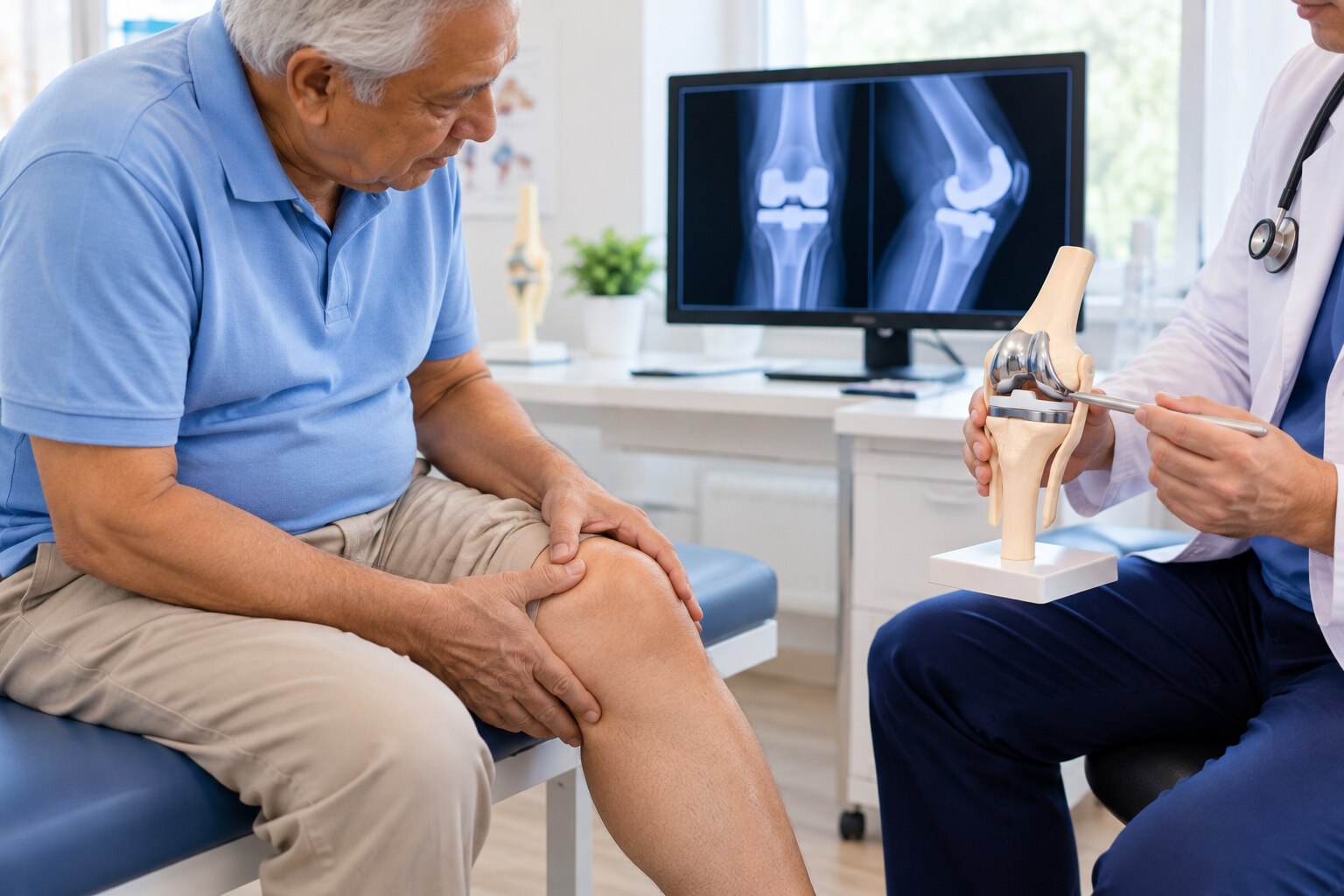
For an older adult, the value of knee replacement depends less on a birthday than on the daily cost of arthritis, the person’s medical fitness, and the support available during recovery. By weighing pain, sleep, walking, independence, surgical risk and realistic rehabilitation demands, families can make a more informed knee replacement decision.
Key takeaways
- Consider surgery when pain persists despite structured non-surgical treatment.
- Assess frailty, heart health, diabetes and mobility before scheduling surgery.
- Compare implant type, surgeon experience, risks and rehabilitation demands.
- Plan help at home, exercises and follow-up before knee replacement.
When Is Severe Arthritis Serious Enough to Consider Surgery?
Persistent knee pain is serious enough to discuss surgery when it remains substantial despite a structured trial of non-surgical care. The decision about knee replacement for severe arthritis depends on the whole picture, not an X-ray alone.
| Finding | Supports considering surgery | What it means |
|---|---|---|
| Symptoms | Daily pain, stiffness, night pain or disturbed sleep | Relief is needed for basic comfort, not just exercise performance |
| Examination and imaging | Tenderness, restricted bending or straightening, deformity, grinding, and X-ray evidence of advanced joint-space loss | The symptoms match structural damage in the knee |
| Daily function | Walking only short distances, difficulty with stairs, dressing, shopping or rising from a chair | Arthritis is reducing independence or creating caregiving needs |
| Previous treatment | Exercise-based physiotherapy, suitable medicines, walking aids, weight management or selected injections have not provided enough relief | Reasonable alternatives have been tried safely and consistently |
Age alone does not rule out surgery. The question is knee replacement worth it for older adults depends on whether improved pain, walking, sleep and independence justify the operation and rehabilitation.
Ask for assessment of the hip, spine, nerves and blood flow if the pain pattern is new, unusually severe or poorly matched to the knee X-ray. Those problems can mimic arthritis and need different treatment.
How Do Health and Frailty Change the Decision for an Older Adult?
An 80-year-old who remains independent and medically stable may recover more easily than a younger person with severe frailty. Age alone does not rule out knee replacement for elderly patients; the knee replacement decision depends on expected pain relief, walking ability, sleep, independence and the support available during recovery.
Frailty matters because it measures physical reserve, not birthdays. A frail person may lose strength quickly after bed rest, struggle with exercises, or need longer help with bathing, meals and walking. Memory problems can lead to missed medicines, unsafe transfers or forgotten exercises, so a reliable caregiver and a clear rehabilitation plan become essential.
- Heart or lung disease that could make anaesthesia, fluid balance or mobilisation harder
- Diabetes that is poorly controlled, increasing infection and wound-healing risk
- Kidney disease that affects medication choices, fluid management and pain treatment
- Anaemia or poor nutrition, which can delay healing and reduce exercise tolerance
- Obesity, weak muscles or poor balance, which can make walking and transfers harder
- Limited family support, transport or home assistance after discharge
These issues do not automatically cancel surgery. The team can sometimes improve risk by treating anaemia, adjusting medicines, controlling blood glucose and arranging physiotherapy or home help before the operation.
Ask what level of walking and pain relief is realistic, which complication is most likely for this individual, and who will provide transport, meals, wound care and exercises. Surgery is worth considering when expected gains in independence outweigh the medical and rehabilitation burden.
What Should You Compare Before Choosing Knee Replacement?
Compare how much each option improves pain, walking, sleep and independence against its burden, duration of relief and risks. Knee replacement benefits and risks become more favourable when severe symptoms continue despite a properly tried non-surgical plan; surgery usually offers greater functional improvement, but requires rehabilitation and carries complications.
| Option | What it can do | Limits or trade-off |
|---|---|---|
| Exercise-based physiotherapy | Builds strength, balance and walking capacity | Does not reverse advanced joint damage; progress requires regular practice |
| Weight management | Reduces load on the knee and may improve surgical fitness | Applies when excess weight contributes; change takes time |
| Walking aid | Improves stability and reduces painful loading | A cane or walker cannot correct joint damage and requires safe technique |
| Brace | Supports alignment or an unstable knee | Fit, skin problems and limited benefit can make long-term use difficult |
| Topical or oral medicines | Provides symptom relief for daily activities | Oral anti-inflammatory drugs may be unsafe with kidney, heart or stomach disease |
| Injection | Corticosteroid injections can provide short-term relief | Repeated injections need planning; timing before surgery requires clinician-specific advice |
| Activity changes | Replaces impact with cycling, swimming or shorter walks | Avoidance can shrink independence if pain remains uncontrolled |
| Knee replacement | Usually gives the strongest lasting improvement in pain and function | Recovery, blood clots, infection, stiffness and persistent pain remain possible |
Choose surgery when these measures no longer provide acceptable comfort or mobility, rather than because an X-ray looks severe alone. Discuss which alternatives were tried, what failed, and whether your health and home support allow rehabilitation; that is the practical knee replacement decision.
What Are the Benefits, Risks and Types of Knee Replacement?
For an appropriately selected older adult, knee replacement can reduce arthritis pain and make walking, stairs, sleep and ordinary self-care easier. It does not create a young, normal knee: kneeling, high-impact sport, stiffness, residual pain or dissatisfaction can remain.
The operation is worth it when improved independence outweighs surgical risk, rehabilitation effort and possible caregiving needs.
| Operation | Damaged parts | What it can realistically improve |
|---|---|---|
| Total knee replacement | The inside, outside and kneecap compartments, with severe damage across the joint | More reliable pain relief and better walking when arthritis affects several compartments |
| Partial knee replacement | One compartment only, with usable ligaments and preserved cartilage elsewhere | Less extensive resurfacing and good function when damage is genuinely limited to one compartment |
| Patellofemoral replacement | The joint between the kneecap and thighbone | Pain from isolated kneecap arthritis, without treating damage in the main compartments |
Weigh knee replacement benefits and risks carefully. Blood clots, infection, stiffness, persistent pain, instability, nerve or blood-vessel injury and further surgery are recognised risks; deep infection occurs in fewer than 2% of total knee replacements according to the American Academy of Orthopaedic Surgeons. Severe weakness, poor balance or untreated medical problems can extend recovery.
Dr.A.K.Sharma-Ortho & joint replacement surgeon can help match the operation to weight-bearing X-rays, ligament stability, the damaged compartments and your ability to complete rehabilitation. A partial replacement is the wrong choice if arthritis is widespread; total replacement is unnecessary when disease is confined to one suitable compartment.
Related service
Restore Mobility and Live an Active Life: Knee Replacement Surgery in Noida At Global Orthopaedics and Speciality Clinics in Noida, we understand... View service → |
What Does Recovery Require After Knee Replacement?
Whether knee replacement is worth it for older adults depends partly on the recovery support available. Before surgery, the team assesses heart and lung health, diabetes control, medicines, frailty, memory, home hazards, and who can help. A physiotherapist teaches exercises, walker use, transfers, and home arrangements before discharge.
- Walking: Expect standing and short walks with a walker on the day of surgery or the next day, followed by gradual increases in distance. Pain and swelling can slow progress.
- Wound care: Keep the dressing clean and dry, follow instructions for changing it, and do not soak the incision until it is healed. Report spreading redness, drainage, wound opening, fever, or worsening pain.
- Blood-clot prevention: Take the prescribed anticoagulant or other thromboprophylaxis for the stated duration. The drug and duration depend on clotting risk, bleeding risk, mobility, and local protocol; ankle pumps and regular walking also matter.
- Stairs: Practise with the physiotherapist before going home. Use a handrail, take one step at a time initially, and have someone nearby.
- Driving: Wait until you can enter and exit safely, control the vehicle, perform an emergency stop, and are no longer taking sedating pain medicine. The surgeon and insurer’s rules apply.
- Home tasks: Prepare meals, laundry, shopping, and bathing support. Avoid lifting, twisting, and prolonged standing early on.
- Activity: After clearance, walking, stationary cycling, swimming, and strengthening are sensible low-impact choices. Kneeling, stiffness, residual pain, and high-impact sport can remain limited.
Recovery is measured in weeks to months, not days. Knee replacement for elderly patients works best when exercise, medication adherence, fall prevention, and caregiver help continue after discharge.
Frequently asked questions
When is severe arthritis serious enough to consider knee replacement?
Discuss knee replacement when persistent pain and limited function continue despite a structured trial of non-surgical care, such as exercise, weight management, medicines or injections when appropriate.
How do health and frailty affect knee replacement for an older adult?
Frailty, heart or lung disease, diabetes, obesity, poor mobility and cognitive problems can change surgical risk and recovery needs. A preoperative assessment helps identify conditions to treat and support to arrange.
What should you compare before choosing knee replacement?
Compare expected pain relief, functional goals, implant options, surgical risks, rehabilitation requirements, hospital support and the surgeon’s experience with your condition.
What does recovery require after knee replacement?
Recovery requires early movement, prescribed exercises, wound care, pain control, walking practice and follow-up. Arrange transport, home assistance and a safe recovery space before surgery.
Keywords