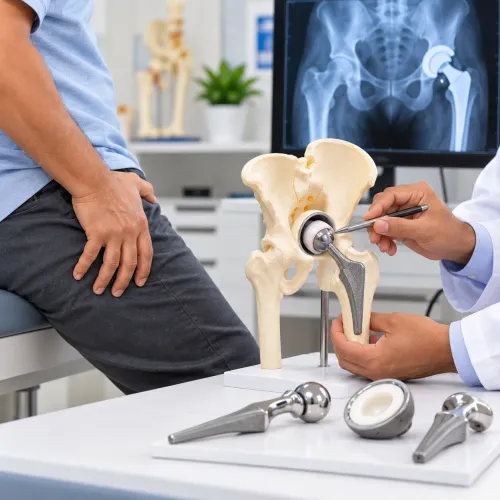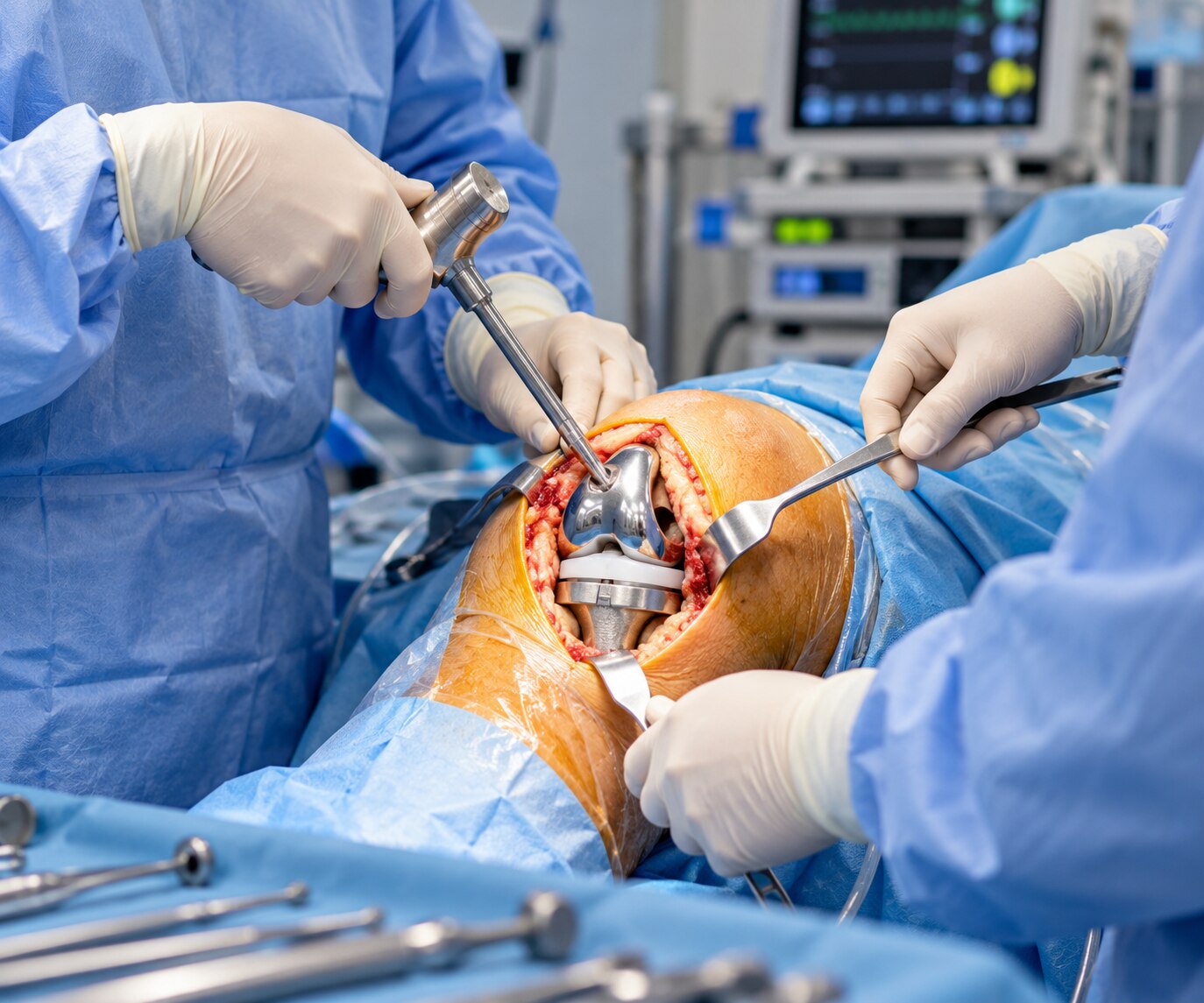
Before you book, confirm that surgery is being recommended for persistent pain and functional loss after appropriate non-surgical care—not from an X-ray alone. You will be able to assess your diagnosis, compare replacement choices, question the surgeon and hospital, and identify the costs and recovery arrangements that belong in a written plan.
Key takeaways
- Bring X-rays, MRI reports, medication lists and records of non-surgical treatment.
- Compare total, partial and revision surgery based on your diagnosis, not advertising claims.
- Verify the surgeon’s qualifications, hospital facilities, infection controls and emergency arrangements.
- Get implant details, itemised costs, risks and rehabilitation milestones in writing.
Does your knee problem justify a replacement assessment?
Persistent knee pain with loss of function despite appropriate non-surgical treatment justifies a knee replacement consultation. The decision must combine your symptoms, physical examination and imaging; an X-ray alone does not prove that replacement is appropriate.
Seek an assessment if you have:
- Pain during walking, standing, stairs or ordinary household tasks
- Pain at rest or at night that disrupts sleep
- A visible bow-legged or knock-kneed deformity
- Stiffness that limits bending or straightening
- A steadily shrinking walking distance, repeated instability or difficulty rising from a chair
Examination findings that strengthen the case include marked loss of movement, joint-line tenderness, deformity that remains during standing, grinding, instability or pain reproduced by loading the damaged compartment. The surgeon should also check your hip, spine and nerves because pain from these areas can imitate knee arthritis.
Tell the surgeon what you have already tried and for how long:
- Physiotherapy or strengthening exercises
- Weight management and activity modification
- Pain-relief medicines or anti-inflammatory treatment
- Walking aids, braces or injections
Replacement becomes more reasonable when these measures failed, produced inadequate relief or were unsuitable because of side effects. The consultation should also identify anaemia, uncontrolled diabetes, smoking, infection, medication-related bleeding risk and major heart or lung disease before surgery is booked.
A knee replacement can improve arthritis pain and walking, but it does not guarantee a normal-feeling knee.
Which records and tests should you take to the consultation?
Bring evidence that the recommendation follows persistent pain and loss of function despite physiotherapy, medicines, injections, activity changes or weight management. The surgeon needs examination findings and imaging, not an X-ray alone. Examination should record range of motion, ligament stability, alignment and walking pattern.
Discuss knee replacement surgery details, including expected pain relief and improved activity, but also stiffness, kneeling difficulty, clicking, pain from another source and possible revision surgery. Preoperative optimisation must address anaemia, high glucose, smoking, obesity-related risk, infection, dental problems, bleeding-risk medicines, and heart or lung disease.
- A symptom timeline covering rest or night pain, walking distance, stair difficulty and deformity.
- Physiotherapy, injection, medicine and activity-modification records, with dates and results.
- Your medication list, allergies, smoking history, previous operations, diabetes and heart or lung conditions.
- Reports of active skin, urinary or dental problems and treatment already completed.
| Investigation | What it helps assess | Bring or request |
|---|---|---|
| Standing weight-bearing knee X-rays | Joint damage under load and affected compartment | Latest films |
| Alignment view | Mechanical axis and deformity | If alignment is unclear |
| MRI or CT | Ligaments, bone loss or another pain source | Previous scans |
| CBC, HbA1c or glucose, kidney tests | Anaemia, diabetes control and medicine safety | Recent reports |
| ECG or heart/lung testing | Anaesthetic risk | When history or examination indicates |
| Urine, skin or dental assessment | Infection requiring treatment first | When symptoms or findings warrant |
How should you compare total, partial and revision options?
The deciding variables are where the cartilage is damaged, whether the major ligaments work, whether the deformity is correctable and whether the knee has already been replaced.
| Option | What it means | When it may fit |
|---|---|---|
| Total replacement | Resurfaces the damaged areas across the knee and uses an implant design suited to ligament function | Arthritis affects multiple compartments, deformity is substantial or ligament support is inadequate |
| Partial replacement | Resurfaces one compartment while preserving more of the natural knee | Disease is confined to one compartment, symptoms match it, alignment is suitable and the ligaments function reliably |
| Revision replacement | Removes or modifies an existing implant and addresses loosening, wear, instability, infection or bone loss | A previous knee replacement has failed; complex components or staged treatment may be necessary |
Partial replacement is not a smaller total replacement. Ask how imaging and examination confirm that damage is limited to one compartment and that the remaining cartilage and ligaments can support it.
Discuss fixation as well: cemented, cementless or hybrid fixation may be selected according to bone quality, age, deformity and activity. Request the implant manufacturer, model, evidence supporting it and the surgeon’s experience with that design.
Expect less arthritis pain and better walking and daily activity, not a normal knee. Stiffness, difficulty kneeling, clicking or pain from another source can remain, and any replacement can eventually need revision. Ask how the proposed option affects these risks, recovery time and likely function.
What should you verify about the surgeon and hospital in Noida?
Do not book on a hospital name alone. Verify the surgeon who will assess you, operate on you and manage complications, then check whether the hospital can support that operation safely.
1. Check the surgeon’s recognised qualification, such as MS or DNB in Orthopaedics, and registration with the National Medical Commission or the relevant state medical council. Ask whether the person is a knee replacement surgeon in Noida and whether a visiting consultant, trainee or another surgeon will perform any part of the procedure.
2. Ask for the surgeon’s recent personal experience, separated into primary, partial and revision knee replacements. Request complication figures over a defined period, including deep infection, blood clots, readmission, stiffness requiring further treatment and unplanned revision. Ask how complications are recorded and who treats them.
A confident answer is more useful than a broad claim of “excellent results.”
3. Confirm the exact hospital where surgery will occur and check its current NABH accreditation certificate, including the accredited facility’s name and validity. Accreditation checks systems; it does not prove an individual surgeon’s results.
4. Ask the hospital to show that it has an on-site anaesthesia service, blood-transfusion capability, intensive-care backup, emergency medicines and a written plan for cardiac, breathing or infection-related deterioration. Confirm who covers you overnight and where you would go if the hospital lacks intensive-care capacity.
If you consult Dr.A.K.Sharma-Ortho & joint replacement surgeon, ask these questions directly rather than relying on a clinic profile or sales coordinator’s summary.
Related service
Restore Mobility and Live an Active Life: Knee Replacement Surgery in Noida At Global Orthopaedics and Speciality Clinics in Noida, we understand... View service → |
What must be written into the consent, quotation and recovery plan?
The consent should state the operated knee and the planned procedure, implant type, cemented or uncemented fixation, anaesthesia plan, expected benefits and alternatives. It should also record that knee replacement surgery usually reduces arthritis pain and improves walking, not that it creates a normal knee.
Discuss residual stiffness, kneeling difficulty, clicking, pain from another source and possible revision surgery.
Before signing, ask for these details in writing:
- The non-surgical alternatives, consequences of postponing surgery, expected improvement, activity limits, driving and return-to-work guidance.
- A blood-clot plan naming the medicine, start date, duration, interactions and warning symptoms. The plan may use low-molecular-weight heparin, aspirin or rivaroxaban after assessing bleeding and clotting risks.
- Preoperative actions for anaemia, high blood sugar, smoking, obesity-related risk, infection, dental treatment, bleeding-risk medicines, or heart and lung disease.
- The quotation’s inclusions and exclusions: surgeon and anaesthetist fees, implant, room, medicines, tests, physiotherapy, follow-up, treatment of complications and revision surgery.
| Plan area | Confirm before booking | Warning sign |
|---|---|---|
| Recovery | Physiotherapy start, home exercises, pain control, wound review and staple removal | No named contact or milestones |
| Discharge | Safe transfers, pain control and walking with the prescribed aid | Fixed one-day promise |
| Persistent symptoms | Who reviews ongoing pain or stiffness and when | No follow-up pathway |
Ask for side-specific knee replacement surgery details in the knee replacement consultation, and seek a second opinion if the diagnosis or implant recommendation remains unclear.
Frequently asked questions
When should you seek a knee replacement consultation?
Seek an assessment when persistent knee pain and loss of function continue despite appropriate non-surgical treatment. The decision should combine your symptoms, examination and imaging rather than an X-ray alone.
Which records should you take to a knee replacement consultation?
Take recent X-rays and MRI reports when available, previous consultation notes, medication and allergy lists, medical history, blood-test results and records of physiotherapy, injections or other non-surgical treatment.
How do total, partial and revision knee replacement differ?
Total replacement treats the damaged surfaces across the knee, partial replacement is limited to one compartment when the remaining knee is suitable, and revision surgery replaces or repairs components from an earlier knee replacement. Your examination, imaging, ligament condition and prior implant history determine the appropriate option.
What should you verify before choosing a knee replacement surgeon in Noida?
Check the surgeon’s recognised orthopaedic qualifications, experience with your procedure, explanation of alternatives and complication management. Also verify the hospital’s operating theatre, inpatient monitoring, physiotherapy access, infection-control practices and emergency support.
What should the consent form, quotation and recovery plan include?
Ask for the planned procedure, implant type and manufacturer, anaesthesia plan, expected risks, alternatives, itemised fees, exclusions, hospital-stay expectations, physiotherapy schedule, walking and driving guidance, follow-up dates and warning signs requiring urgent care.
Keywords