Swelling that remains after a sprain, strain, impact or hard training session is not always part of normal recovery. You will learn how to judge the pattern, protect the injury during the first 72 hours, recognise emergency warning signs and decide when examination, physiotherapy or imaging is needed.
Key takeaways
- Swelling should peak within 24 to 48 hours and then steadily improve.
- Use protection, rest, ice, compression and elevation during the first 24 to 72 hours.
- Stop training if swelling returns, pain increases or movement becomes restricted.
- Seek urgent care for deformity, numbness, severe pain or a cold, pale limb.
How long should swelling last after a sports injury?
Most mild swelling from a sprain, strain or bruise peaks within 24 to 48 hours, then steadily decreases over the next several days. Bruising, stiffness and slight puffiness can remain for two to three weeks, but the trend should be improving rather than repeatedly worsening.
Persistent swelling after sports injury needs assessment when recovery stops moving forward. Arrange a prompt review if:
- Pain or swelling is increasing after the first few days
- You still struggle to walk, use the limb or move the joint normally
- The joint gives way, catches or locks
- Swelling returns substantially after ordinary activity
- You cannot explain the swelling as part of a clear, steady recovery
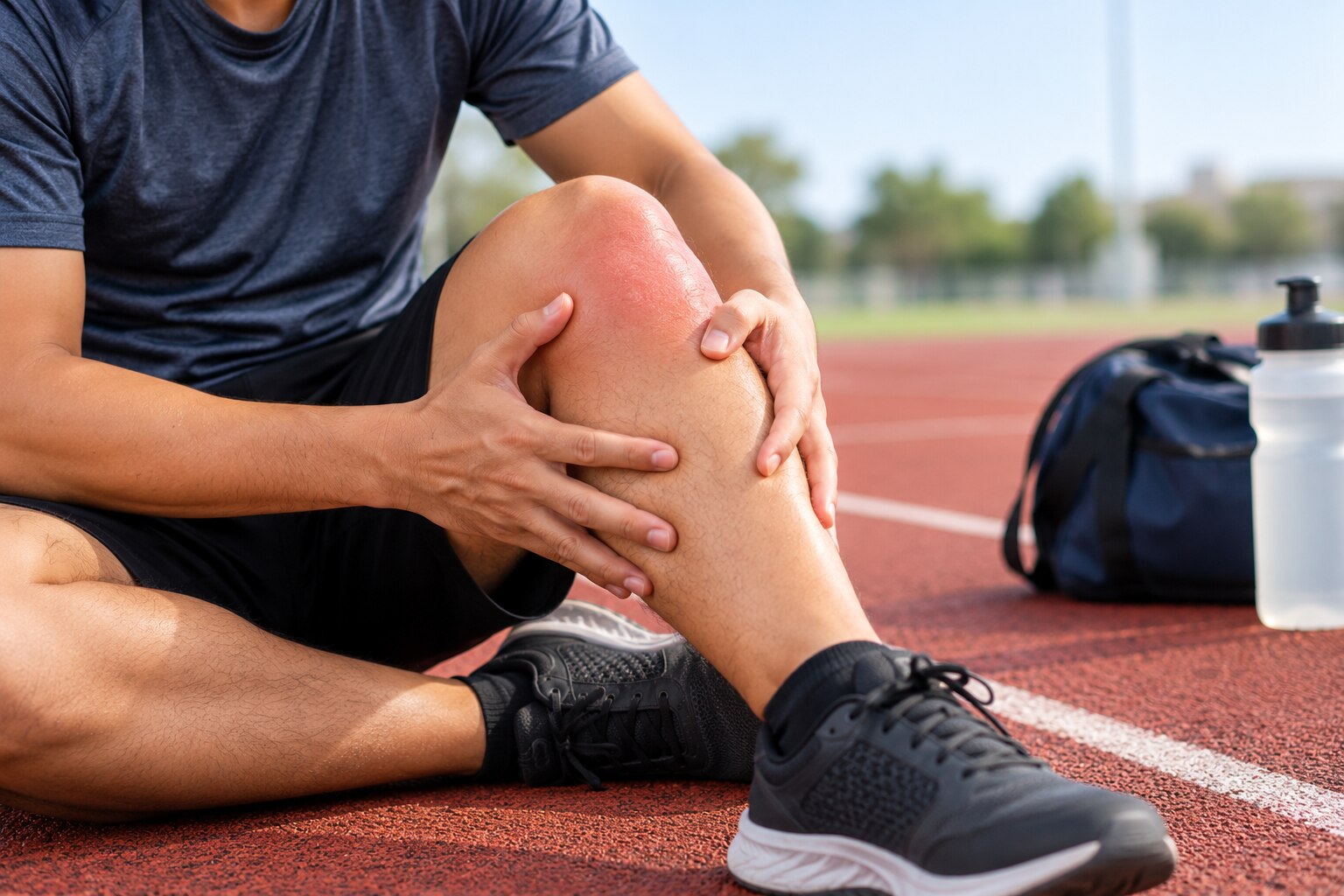
Joint swelling after exercise is not always routine soreness. Fluid inside the joint can follow a ligament or meniscus injury, fracture, bleeding, infection or inflammatory arthritis. Knee swelling that appears within a few hours of an injury deserves particular attention because it can signal bleeding or major internal damage.
Do not judge recovery by the calendar alone. Before returning to sport, you should have near-normal pain-free movement, strength and balance, and tolerate sport-specific loading without a meaningful increase in swelling afterward.
Limping, instability or swelling that lasts into the next day means the injury needs a lower load and, if it persists, clinical assessment rather than indefinite ice alone.
What to do during the first 24 to 72 hours
Protect the injured area from further load, but do not immobilize yourself completely. Stop the sport, running, jumping or lifting that provokes pain; use gentle, pain-free movement to limit stiffness unless a clinician suspects a fracture or dislocation.
| Action | What to do | Stop or avoid when |
|---|---|---|
| Protection | Leave the activity and support the area; use crutches only if advised | Walking increases pain or you cannot bear weight |
| Ice | Wrap ice or a cold pack in cloth for 15–20 minutes | Never place ice directly on skin; stop if skin becomes numb, pale or painful |
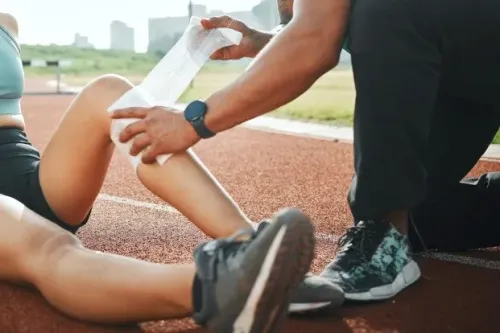
| Compression | Apply a firm, even elastic bandage | Loosen it for numbness, tingling, increasing pain, coldness or discoloration |
| Elevation | Raise the injured limb above heart level when resting | Do not force a painful position |
Avoid heat packs, hot baths and vigorous massage during the first 24–48 hours; increasing blood flow can worsen swelling. Do not “walk it off” through escalating pain, and do not rely on complete bed rest for several days because stiffness and weakness can delay recovery.
Rapid swelling within a few hours, especially around the knee, needs medical assessment for bleeding or major internal injury. Joint aspiration is not routine treatment: a clinician uses it selectively to relieve pressure or distinguish blood, infection, crystals or another cause, and sends fluid for analysis when infection is possible.
When swelling returns after training or exercise
If running, jumping, lifting or practice brings the swelling back, stop that activity rather than training through it. Joint swelling after exercise means the injured area is not tolerating its current load; repeated flare-ups can prolong tissue damage and delay recovery.
- Reduce the intensity, distance, weight or practice time that triggers swelling. Choose low-impact movement only if it stays comfortable and does not increase swelling later that day or the next morning.
- Record the activity, duration, pain level and time swelling appears. This pattern helps identify whether cutting speed, repetitions, hills or resistance makes the difference.
- Keep gentle, pain-free range-of-motion exercises, but avoid forceful stretching, pivoting and deep loading while the joint remains swollen.
- Increase training in small steps only when walking is normal and the area has near-normal pain-free movement, strength and balance. Test sport-specific movements before full practice.
Do not rely on ice alone while continuing the same workload. Arrange a sports injury assessment if swelling returns every session, walking remains difficult, pain is worsening, or the joint gives way or locks.
Rapid knee swelling within a few hours of an injury deserves prompt medical assessment because bleeding or a major internal injury can be involved. A hot, red joint with fever needs urgent care.
When swelling needs emergency care or a prompt appointment
Severe or rapidly worsening symptoms need emergency services, not a routine search for a sports injury doctor near me. Go immediately if the injured area becomes rapidly tight and swollen, pain is extreme or disproportionate, or stretching the nearby muscles causes severe pain.
Numbness, weakness, or a pale, blue, cold hand or foot signals possible nerve or blood-flow compromise.
| Urgency | Warning signs | What to do |
|---|---|---|
| Emergency care now | Deformity, an open wound, inability to bear weight with severe pain, rapidly increasing swelling, numbness, weakness, or a cold or discoloured limb | Call emergency services or go to an emergency department |
| Emergency care now | One-sided calf swelling with warmth, redness, or tenderness plus chest pain, sudden breathlessness, coughing blood, fainting, or a fast heartbeat | Seek emergency care for possible pulmonary embolism |
| Prompt appointment | Stable but persistent swelling, worsening pain, difficult walking, repeated giving-way or locking, or no clear improvement after several days | Arrange an orthopaedic or sports-medicine assessment |
For sports injury swelling in Noida, choose an appropriately qualified clinician rather than the closest clinic when symptoms are worsening or function remains limited.
Dr.A.K.Sharma-Ortho & joint replacement surgeon can determine whether examination, imaging, or joint-fluid analysis is needed; aspiration is not routine and is especially important to analyze when infection, blood, or crystals are possible. Do not return to sport while limping, unstable, or developing more swelling after activity.
Related service
Get Back in the Game: Expert Sports Injury Treatment in Noida Are you a athlete sidelined by a sports injury? At Global Orthopaedics and Speciality... View service → |
What examination and tests can find the cause
The examination begins with the injury mechanism, swelling speed, exact tenderness and movement limits. Swelling within a few hours after a knee injury raises concern for bleeding or major internal damage. The clinician compares both sides, checks stability, strength, sensation, pulses and ability to bear weight.
- A sprain causes pain around a ligament; stress tests that gently load the ligament reveal looseness or pain.
- A strain affects muscle or its tendon; resisted movement and stretching reproduce pain, while a gap may indicate a tendon tear.
- Meniscus injury causes joint-line tenderness, catching or locking; rotation and compression tests help assess it.
- A fracture or bone injury causes focal bone tenderness and difficulty bearing weight, even when swelling looks modest.
- Heat, redness, fever, chills or severe movement restriction point toward infection; multiple swollen joints or prolonged morning stiffness suggest inflammatory arthritis.
An X-ray checks fracture or dislocation but cannot rule out a torn ligament, meniscus, tendon, bone bruise or early stress injury. MRI is appropriate when examination findings suggest internal damage, symptoms persist despite suitable care, or the result would change treatment. Ultrasound helps assess superficial tendons, muscles, fluid collections and selected vascular concerns.
Aspiration is not routine for every swollen joint. If infection, bleeding or crystal arthritis is possible, the fluid should be tested for cell count, bacteria and crystals rather than simply removed.
Searching sports injury for swelling treatment in noida should lead you to an appropriately qualified clinician; persistent, stable swelling needs an appointment, while infection signs or inability to bear weight require urgent assessment.
Frequently asked questions
How long should swelling last after a sports injury?
Mild swelling usually peaks within 24 to 48 hours and improves over several days. Bruising, stiffness and slight puffiness can last two to three weeks, but repeated worsening needs assessment.
What should I do during the first 24 to 72 hours?
Protect the injured area, reduce activity, apply a cold pack wrapped in cloth for short periods, use comfortable compression and elevate the limb. Stop if numbness, skin colour changes or increased pain develops.
Why does swelling return after training or exercise?
Returning to exercise too soon, increasing intensity quickly or stressing an incompletely healed ligament, tendon or joint can trigger swelling. Reduce the load and arrange an examination if it keeps returning.
When does sports injury swelling need emergency care?
Seek emergency care for a visible deformity, inability to bear weight, severe or rapidly increasing pain, numbness, loss of movement, or a cold, pale or blue limb.
Keywords